Considering Donor Conception
What research and other families' experiences say about building a family with donor sperm.
If you've reached a point where biological fatherhood through your own sperm is unlikely, donor conception is one path forward. This page presents some data and perspectives that may be useful as you think through that decision.
Genetics and Environment: What Makes a Person Who They Are
Research on heritability, the study of how much of a trait is explained by genetics versus environment, consistently shows that who a person becomes is shaped by both. On average, across most traits studied, roughly half the variation between people is attributable to genetics and roughly half to environment. The exact split varies by trait.
The chart below shows estimated heritability (the genetic component) for a range of traits. Traits on the left are more genetically determined; traits on the right are more influenced by environment.
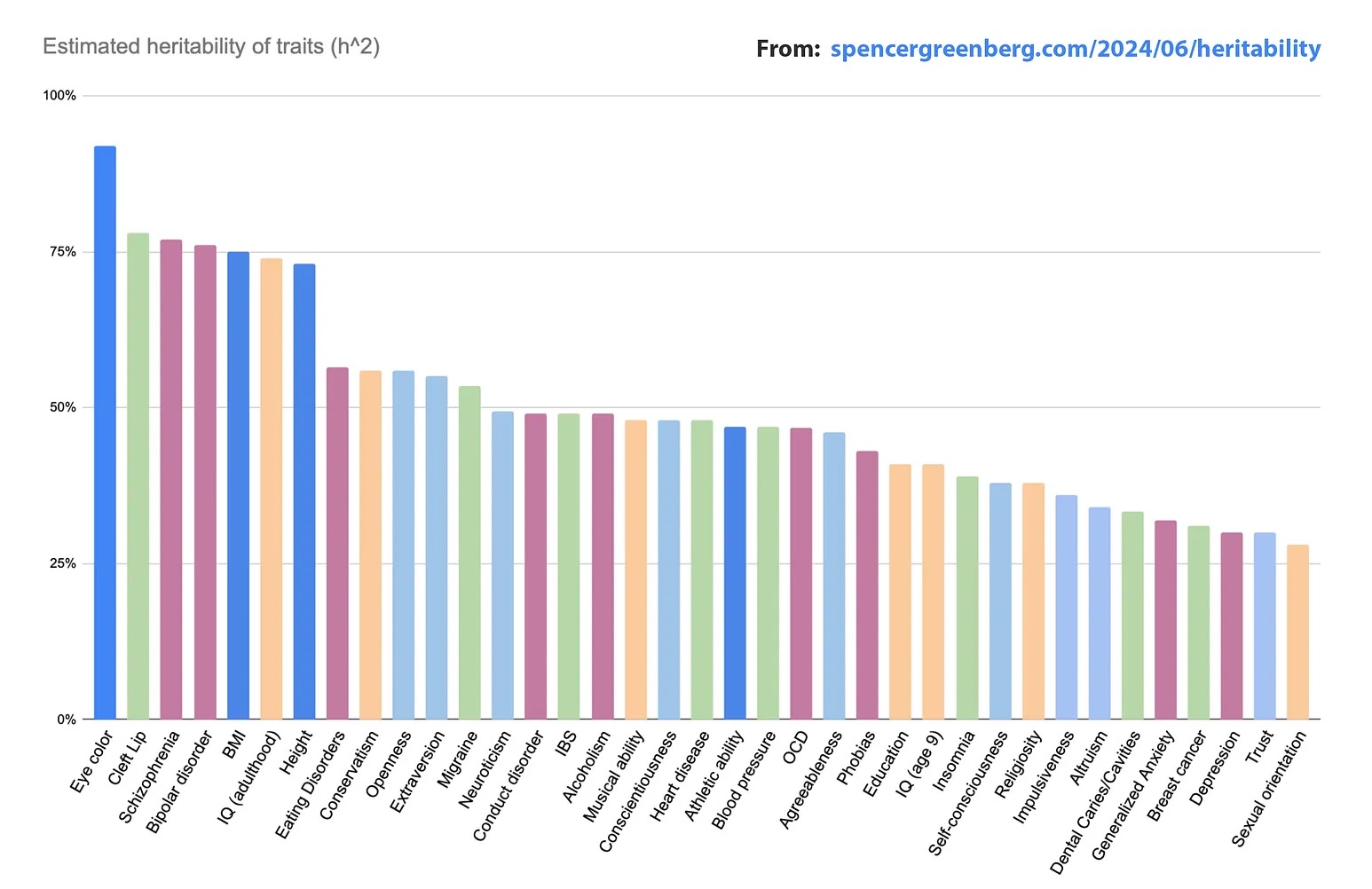
Source: spencergreenberg.com/2024/06/heritability
What this means in the context of donor conception
A child's traits are shaped by two broad forces: genetics and environment. The genetic component comes in equal halves: 25% from the mother, 25% from the father (or in this case, the donor). The environmental component (the home, the parenting, the values, the daily life) is provided by the parents raising the child.
In a donor-conceived family:
- ~50% environment, shaped by the parents raising the child (you and your partner)
- ~25% genetics from the mother, your partner's biological contribution
- ~25% genetics from the donor
Approximately 75% of what shapes your child comes from you and your partner, through the environment you create and your partner's genetics. The remaining 25% comes from the donor.
That 25% is also something you have some control over. When selecting a donor, you can choose someone whose physical characteristics, education, health history, and background are similar to your own. This doesn't make the child "yours" genetically, but it does mean the genetic contribution from the donor can be chosen thoughtfully rather than being entirely random.
These numbers are averages across many traits. Some traits (like eye color) are almost entirely genetic. Others (like trust, religiousness, or depression) are more heavily shaped by environment. The traits that tend to matter most in day-to-day life, like personality, values, interests, and sense of humor, are substantially influenced by the environment a child grows up in.
A Perspective on Parenthood
One way of thinking about this: no parent owns their child, and no child is owned by their parents. This is true in every family, not just donor-conceived ones.
The moment an embryo is created, whether through natural conception, IVF, or donor conception, it is a new individual. It is no longer just an egg or a sperm. It is a distinct person who will grow into someone with their own thoughts, preferences, personality, and life. Every parent, regardless of how their child was conceived, is raising a separate human being who will ultimately become their own person.
Biology contributes to who a child is, but it does not define the parent-child relationship. What defines that relationship is presence, care, consistency, and love, all things that are chosen, not inherited. Adoptive parents, stepparents, and donor-conception parents demonstrate this every day.
The question isn't whether a donor-conceived child is "really yours." The question is whether you're ready to be a parent, to show up, day after day, for someone who depends on you. That decision is the same one every parent makes, regardless of genetics.
For a much more personal perspective from a father of two donor-conceived children, see Walter's letter. For books and resources, see Books and Resources.